Chief Bromden escapes the hospital
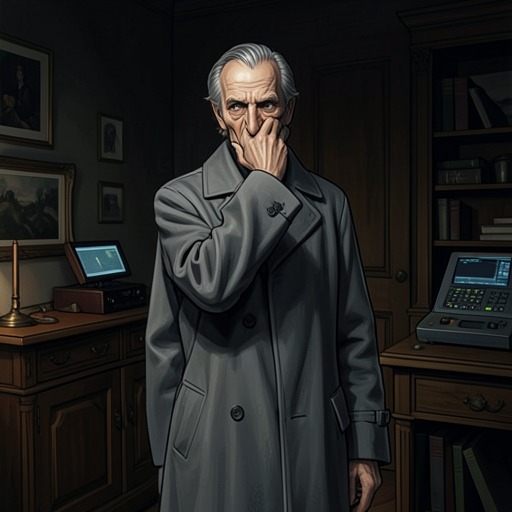
One Flew Over the Cuckoo's NestChief Bromden escapes the hospital by forcing the Tub-room control panel through a window and following it into the night. The act converts a possibility Randle Patrick McMurphy had once demonstrated into a route out of confinement: Chief Bromden leaves the ward, crosses the grounds, and sets out alone toward the highway. His flight ends the hospital’s immediate hold over him, but his thoughts turn not only toward Canada; they also lead back to the Columbia Gorge, his village, and a past from which he has been absent for a long time.
The Decision and McMurphy’s Example
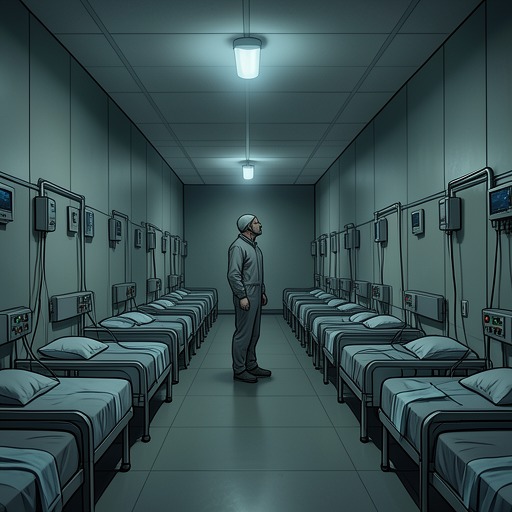
Before Chief Bromden moves, Scanlon urges him to leave and offers to cover for him by saying that he saw Randle Patrick McMurphy up and moving after Chief Bromden had gone. The proposed explanation is bound to the dead man and to what the others might be asked about after the escape. Chief Bromden answers that simply asking for the door to be unlocked would not get him out. Scanlon replies that Randle Patrick McMurphy had shown him how once, during the first week, and asks him to remember. The exchange makes the escape more than an improvised break: it recalls an earlier demonstration of physical possibility and places McMurphy’s influence at the threshold of Chief Bromden’s own action.
Chief Bromden does not answer Scanlon’s reminder, and Scanlon says nothing more. After a few quiet minutes, Chief Bromden gets up and dresses. The silence matters as a change from discussion to decision: no permission is requested, and no further plan is spoken aloud. He reaches into Randle Patrick McMurphy’s nightstand and tries on his cap. It is too small. Chief Bromden feels ashamed of the attempt and leaves the cap on Scanlon’s bed as he walks out of the dorm. The gesture briefly makes McMurphy’s departure seem available through an object, then marks the difference between borrowing another man’s identity and making an escape of his own.
Breaking Through the Window
Moonlight comes through the Tub-room windows onto the heavy control panel, the chrome fixtures, and the glass gauges. Chief Bromden takes a deep breath, grips the levers, and heaves. He feels the weight at his feet; on the next effort, wires and connections tear out of the floor. He raises the panel to his knees, braces it with an arm and hand, and presses its cold chrome against his neck and the side of his head. The escape is accomplished not by finding an unlocked exit but by moving a piece of the room’s equipment that has seemed fixed in place.
With his back toward the screen, Chief Bromden turns and uses the panel’s momentum to smash it through the screen and window. Glass scatters into the moonlight. He pauses, panting, and briefly considers returning to the dorm for Scanlon and some of the others. The possibility of taking companions with him is present, but it does not become a second rescue attempt. Hearing the black boys’ shoes squeak as they run down the hall, he puts a hand on the sill and vaults after the panel. The sound of their approach gives the solitary escape its urgency: Chief Bromden goes through the opening before anyone can stop him.
Across the Grounds and onto the Road
Outside, Chief Bromden runs across the hospital grounds toward the highway, in the direction where he remembers seeing a dog go. He describes his strides as enormous, seeming to float before each foot meets the earth. His sense of movement culminates in the feeling of flying and being free. He knows that people generally do not pursue an AWOL patient, and he knows Scanlon can handle questions about the dead man; neither fact makes him stop. He runs for miles before slowing and walking up the embankment to the highway. The distance is both practical and emotional: even when pursuit seems unlikely, he continues away from the hospital rather than treating the broken window as sufficient escape.
A truck carrying sheep gives him a ride north. Its driver is a Mexican man, and Chief Bromden persuades him with a story that he is a professional Indian wrestler whom a syndicate tried to lock up in a nuthouse. The account is a cover, not an explanation of the actual escape. The driver responds by stopping quickly, lending Chief Bromden a leather jacket to cover his hospital greens, and giving him ten dollars for food while he hitchhikes toward Canada. Before the truck leaves, Chief Bromden has the driver write down his address and promises to send the money when he has got ahead. His departure therefore begins with practical help from a stranger, accepted alongside an explicit promise of repayment.
The Road Ahead and the Home Left Behind
Canada is a possible destination, not yet a settled endpoint. Chief Bromden thinks he may eventually go there, but first considers stopping along the Columbia River and checking around Portland, Hood River, and The Dalles. He wants to find people he knew from the village who have not drunk themselves into incapacity and to see what they have been doing since the government tried to buy their right to be Indians. The escape opens onto a return in thought to a specific community and landscape, not simply an abstract journey away from the hospital.
He has also heard that some members of the tribe have built ramshackle wooden scaffolding over the great hydroelectric dam and are spearing salmon in its spillway. This is something he would like to see, rather than an event he reports witnessing. More privately, he wants to look over the country around the gorge again so that it can become clear in his mind. The distinction between hearing about the scaffolding and wanting to see the land again preserves the uncertainty of his future: the escape grants him movement and possibility, but the narrative does not show him reaching Canada or returning to the village. Its closing recognition is that he has been away a long time. The broken window thus leads toward freedom while also exposing the distance between escape and recovery of a home remembered only in part.